


The Essential Local SEO Checklist From Our Digital Marketing Experts
Learn what your business needs to know about reaching a nearby audience
Local SEO is a must for any business aiming to reach customers or clients in the area where your business is established.
You have likely searched on Google before for something like “painting company in Orlando” or “accounting firm near me” when you needed these services. Others do the same when they look for the services or products your business offers.
If you’re planning to hire a digital marketing agency to conduct SEO for your business, continue reading the checklist below so that you can gain some basic knowledge, better support their efforts, and achieve greater results.
What is local SEO?
Local SEO is a search engine marketing technique that helps improve your business’s search visibility to reach a local audience. Any business with a physical location or that serves a specific geographic region can benefit from local SEO.
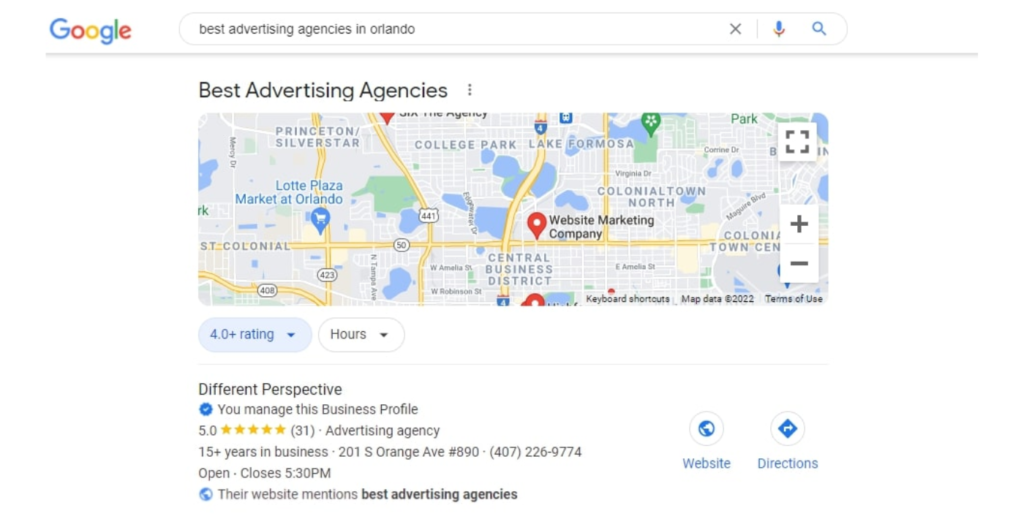
When you search for keywords related to your business, a map with several listings below it will appear, called a local map pack. The goal for many businesses conducting local SEO is to rank in this map pack.
#1: Understand your ranking factors
To rank well in local SEO, you need to focus on a range of signals that show search engines that your business serves a specific geographic region and wants to attract customers from that region.
These ranking factors give search engines insight into the importance and relevance of your business’s website. The most influential ones include:
- Google Business Profile signals: Your Google Business Profile is the single largest input the algorithm uses for the local map pack, accounting for around 32% of ranking weight in 2026. Your website still matters, but the content on your page directly supports your Google Business Profile listing and its ranking.
- Review signals: A Positive review on your Google Business Profile page can greatly help your business’s local SEO efforts. Reviews, along with business owners’ responses, show that customers trust businesses and that owners care enough to respond.
- Social signals: This type of signal refers to a website’s social media presence and visibility as seen by search engines.
- On-page signals: The content of your website, your local keywords, NAP details (name, address, phone), and overall site authority account for about 19% of local ranking weight. A well-optimized website tells Google what you do and where you do it.
Related resource:
How To Respond To Google Reviews
#2: Optimize your website
It’s highly recommended that you and your team work with an experienced digital marketing agency that offers comprehensive SEO services to complete this step and the following steps.
Optimizing your website is one of the most important things your business can do to improve local SEO rankings. Many aspects go into the SEO optimization of a website, including:
- On-page SEO includes creating high-quality content, optimizing your pages for target keywords, and image optimization.
- Technical SEO checks for duplicate content, broken links, and accessibility.
- Mobile optimization encompasses ensuring that all of your pages are mobile-friendly and that all links still work on mobile devices.
Mobile is a critical part of the picture. Mobile devices now account for around 54% of all website visits in the United States and roughly 60% globally.
Google uses mobile-first indexing, meaning it primarily indexes and ranks web pages based on mobile versions. It’s important that the content on your business’s desktop website is the same as the content on your mobile website and that your mobile website has the same clear headlines and titles.
Learn more:
The importance of SEO in digital marketing
#3: Enhance your Google Business Profile listing
A strong Google Business Profile is key to providing search engines with local information about your business for potential customers. It’s important to keep everything on your listing consistent with the information on your website and social media profiles.
When Google sees that all your information across every platform is consistent, it takes that as a sign that your business is legitimate and ranks it higher. If your business’s name, location, or phone number changes, you must update your profile with the new information as soon as possible.
If your business already has a Google Business Profile, here’s where to focus:
Claim your listing
This step is essential to optimizing your GBP profile. As the owner of your listing, you can add and update information, ensuring that no one else can claim your business as their own.
Add photos
High-quality photos of the inside and outside of your business location make your listing more visually appealing.
Encourage reviews
As mentioned above, reviews are an important ranking factor and show that you have loyal customers.
Enter a geographical radius
This step is huge for local SEO efforts, and it will help you reach your local target audience more easily.
Select a business category
This will help potential customers understand exactly what your business does and the services it provides.
Learn more:
How To Claim (Or Reclaim) Your Google My Business Listing
#4: Utilize social media
Social media is not typically thought of as playing a role in SEO, but it can benefit your online visibility when used properly.
While Google does not treat social media engagement as a direct ranking factor, an active presence increases your business’s prominence, which is a recognized local SEO factor.
Social media platforms like Facebook, LinkedIn, and Instagram are great for building a loyal customer base and sharing relevant information that your followers will find interesting.
It’s also a good idea to consider creating a profile on other social media sites, like Yelp, Tripadvisor, and Angi (previously Angie’s List), depending on the type of business you own.
#5: Prepare for AI-powered search
Customers increasingly find local businesses through AI Overviews and conversational AI assistants, which draw on the same signals as traditional local search. The good news is that the work above already supports AI search, with a few areas worth extra attention:
- Keep your business information complete and consistent across your Google Business Profile, website, and citations.
- Add LocalBusiness schema to give AI tools structured data they can trust.
- Maintain a steady flow of recent reviews, as AI summaries often reflect the sentiment and themes inside them.
Bringing it all together
Local SEO rewards businesses that show up consistently wherever customers look. A well-optimized website, a complete and active Google Business Profile, a healthy review profile, social media presence, and structured data work together to make your business easy to find, easy to trust, and easy to choose.
If you’re ready to strengthen your local search presence, working with an experienced digital marketing agency can help you turn this checklist into a clear strategy with measurable results.
Looking for a marketing partner to help with local SEO?
At Different Perspective, we can help your business create an SEO campaign that effectively increases your online visibility in search engines like Google and helps you get found by your target audience.
Contact us today to learn more.
 Back to all blogs


